Journal of Cardiovascular Medicine and Cardiology
A rare case of Contusio Cordis: Fist fight leading to an Acute Myocardial Infarction due to Left Anterior Descending artery dissection
Author and article information
Cite this as
Patel H, Sundermurthy Y, Bhutani S, Bikkina M (2017) A rare case of Contusio Cordis: Fist fight leading to an Acute Myocardial Infarction due to Left Anterior Descending artery dissection. J Cardiovasc Med Cardiol 4(2): 026-028. 10.17352/2455-2976.000045
Copyright License
© 2017 Patel H, et al. This is an open-access article distributed under the terms of the Creative Commons Attribution License, which permits unrestricted use, distribution, and reproduction in any medium, provided the original author and source are credited.Abstract
Background: The study of coronary artery disease has been quite thorough. But there is few study on coronary vein disease. In clinical practice, some patients have suspicious symptoms of coronary artery disease without any evidence of coronary artery spasm, but coronary angiography showed no obvious stenosis in coronary artery. It may have relationship to coronary venous dysfunction. This study aims to develop a coronary vein ligation model, to investigate the effect of coronary vein occlusion on myocardial cells in normal miniature pigs.
Methods: Adult minifies were divided into control group and intervention group. The coronary venous occlusion model was made by clamping the central vein. Myocardium was isolated from the myocardium and the myocardium was observed by transmission electron microscopy.
Results: There were no significant changes in the sham operation group (control group). Mitochondrial edema, cristae broken, hyperplasia and auto phage some appeared in the operation group (intervention group).
Conclusion: The ligation of the coronary vein causes dysfunction of myocardial cells. It gives us inspiration, coronary vein occlusive disease may be underestimated. It may be some causes of angina for patients with normal coronary angiography.
Introduction
Cardiac lesions resulting from blunt chest injuries can present as cardiac contusion; ventricular free wall rupture; ventricular septal rupture; and valvular lesion [1]. But acute Myocardial infarction (MI) from contusio cordis is a very rare complication. Here we present a case of fist punch to the chest leading to distal Left Anterior Descending (LAD) artery dissection causing acute MI.
Case
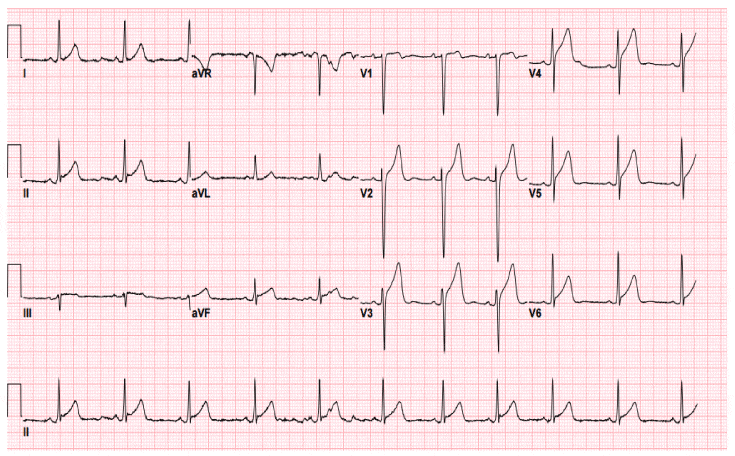
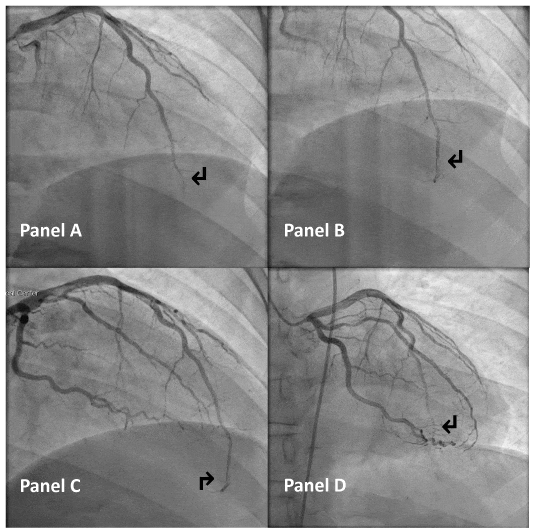
A 28 year old Hispanic male with history of alcohol abuse presented to our hospital with chest pain that started 7 hours prior to arrival after he sustained a fist punch to the chest during an altercation at a bar. It was associated with shortness of breath and palpitations. He tried ibuprofen with no relief. Vital signs were stable. Physical exam revealed ecchymosis of the mid sternal region with chest wall tenderness. ECG showed normal sinus rhythm and ST segment elevations in anterior and inferior leads (Figure 1). Troponin-I was elevated at 0.32 ng/ml. 2D ECHO showed normal left ventricular ejection fraction with no regional wall motion abnormality, no effusion or acute valvular pathology. Patient’s chest pain improved with sublingual nitroglycerine; however, 2nd set of Troponin-I was 14.12 ng/ml, so he underwent coronary angiography that showed dissection of distal LAD with thrombus (Figure 2). Owning to small caliber vessel, patient was managed conservatively with aspirin, clopidogrel, atorvastatin and eptifibatide. Heparin drip, which was started prior to angiography, was discontinued and eptifibatide was given for 18hrs. He made good recovery and was discharged on aspirin and clopidogrel with a follow up in 6 weeks.
Discussion
Acute MI is rare in young adults but must be kept in the differential in the setting of blunt chest trauma as well as contact sports. Very rarely, later can cause coronary dissection and suspected mechanism is shearing of arterial wall due to dramatic acceleration/deceleration forces leading to intimal tear [2]. Diagnosis is confounded due to chest wall tenderness and myocardial contusion, which can also present with ST elevations on ECG; hence, a high index of suspicion is needed to avoid delay in diagnosis and instituting appropriate therapy. Of note, rising troponin is an important clue that can differentiate coronary dissection from myocardial contusion. Treatment of choice for dissection is conservative, esp. if patient is hemodynamically stable with no ongoing ischemia [3]. In our patient, distal LAD was involved and thrombolysis in myocardial infarction (TIMI) flow was >2, so he was managed conservatively.
Conclusion
Traumatic dissection of LAD artery should always be in the differential in a patient with chest pain after blunt chest trauma, as it is more vulnerable likely due to its anterior location.
Supplementary videos showing angiography of left coronary system:
Video 1 – Right cranial view
Video 2 – Left cranial view
Video 3 – Right caudal view
Download VideosReferences
- Longo GC, Wolney de AM, Villacorta H, Nani da Silva E, Paula Maira AH, et al. (2014) Contusio Cordis Associated with Atrioventricular Block and Tricuspid Regurgitation. Arq Bras Cardiol 103: e22–e25. Link: https://goo.gl/GoYeqw
- Poyet R, Capilla E, Kerebel S, Brocq FX, Pons F, et al. (2015) Acute myocardial infarction and coronary artery dissection following rugby-related blunt chest trauma in France. J Emerg Trauma Shock 8: 110–111. Link: https://goo.gl/iAHILq
- N Guragai, H Patel, K Patel et al. (2017) Spontaneous coronary dissection of left anterior descending artery complicated by retrograde extension of dissection and involvement of left main artery: successful management with percutaneous coronary intervention. Minerva Cardioaniol 65.
Advertisement